

Full-mouth reconstruction in modern practice: timeless principles from one of the UK’s top clinicians who shaped restorative dentistry in the UK
How classic restorative fundamentals make complex cases more predictable. And why thousands of dentists have chosen to learn this principle-led approach directly from Professor Paul Tipton through Tipton Training’s 1-Year Certificate in Restorative Dentistry.
Full-mouth reconstruction is one of the most professionally rewarding areas of restorative dentistry—but it is also one of the most demanding. Cases involving severe tooth wear, erosion, reduced restorative space, drifting, fractured restorations, or a history of repeated failure require far more than the newest ceramic or this year’s trendiest workflow.
Predictable success doesn’t come from products. It comes from principles: structured diagnosis, functional control, thoughtful sequencing, and restorative design that is stable, aesthetic, and built to last.
Yet these principles are rarely taught in a clear, systematic way. With an abundance of conflicting techniques and commercial systems, clinicians often struggle to know what to trust—and how to build a coherent approach that works consistently.
This article revisits the core concepts Professor Paul Tipton is renowned for—principles that underpin predictable outcomes in advanced restorative dentistry. They form the backbone of Tipton Training’s 1-Year Certificate in Restorative Dentistry, Europe’s most established restorative programme, built to give clinicians genuine confidence in planning and delivering advanced treatment.
These are the principles that make complex cases repeatable, predictable, and professionally fulfilling.
1) Start where all predictable rehabilitation begins: diagnosis and design
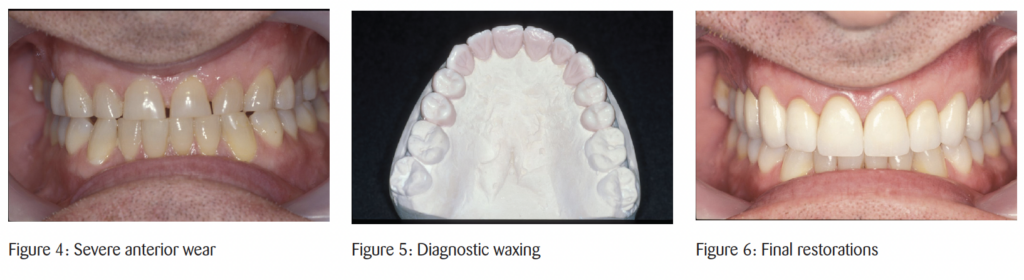
Predictable treatment requires a clear view of the endpoint. In cases involving wear, erosion, loss of vertical dimension, drifting, or fractured restorations, guesswork is expensive. The most successful clinicians plan from the finish line backwards.
A comprehensive diagnostic workflow should establish:
- Risk: caries, periodontal stability, parafunction, erosion risk, compliance, and maintenance ability.
- Function: guidance pathways, interferences, range of motion, and the envelope of function.
- Aesthetic goals that are clear, realistic, and measurable.
- A staged plan that is both deliverable and safe.
For worn dentitions or aesthetic-functional rehabilitations, a full diagnostic wax-up (or digital equivalent) remains indispensable. It clarifies the proposed occlusal scheme, restorative thickness, and aesthetic outcome, while providing a communication tool for both the patient and laboratory. Crucially, it dictates sequencing—what must happen first, what can wait, and what must be stabilised before definitive care.

2) Occlusal principles: the foundation of predictable outcomes
When complications arise in full-mouth rehabilitation, materials, preparations, or cementation are often blamed. But in most cases, the problem originated earlier—with unstable function, unaddressed occlusal interferences, or poorly designed anterior guidance.
A strong occlusal foundation is non-negotiable!
The five classic occlusal principles remain as essential today as ever:
- A stable, reproducible mandibular position as the reference point, either RAP or ICP.
- A mutually protected occlusion, where anteriors protect posteriors, and posteriors protect anteriors.
- Planned anterior guidance—protective, comfortable, and compatible with individual function in lateral and protrusive movements.
- Control of interferences, especially non-working contacts that overload restorations (Class 2 leverage).
- Posterior stability to provide dependable stops.
These principles elevate not only full-mouth cases, but also everyday dentistry, from single crowns to adhesive bridges.
This is why occlusion is a major pillar of Tipton Training’s 1-Year Certificate in Restorative Dentistry. With six dedicated modules and functional integration across the programme, clinicians learn not just the theory, but how to apply it predictably at the chairside.
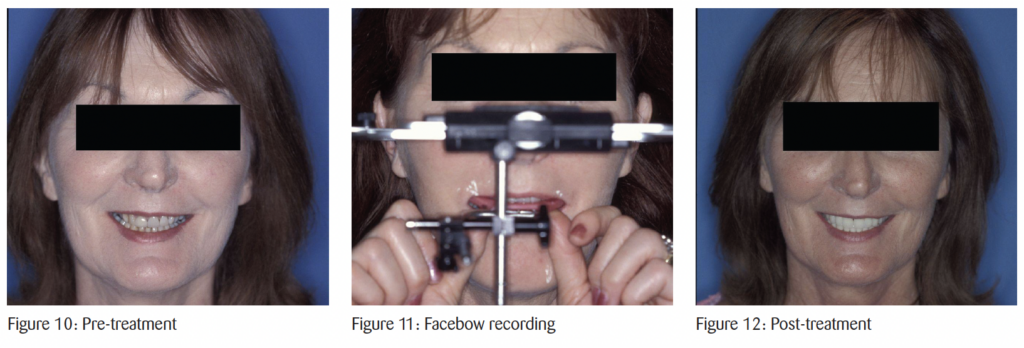
3) Records and articulation: reducing guesswork as complexity grows
The more complex the case, the more valuable precise records become. High-quality records and thoughtful articulation:
- reduce chairside adjustments,
- protect the intended occlusal scheme,
- and improve communication with the technician.
Not every case requires full mouth reconstruction, but every complex case benefits from a clinician who understands when—and why—to use different recording and articulating techniques for maximum accuracy.
4) Creating restorative space safely: vertical dimension, splints, and staged verification
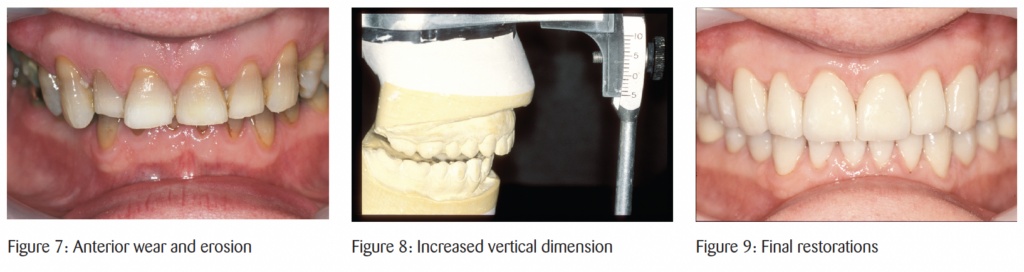
One of the biggest challenges in wear and erosion cases is insufficient restorative space. Increasing vertical dimension can be transformational—both functionally and aesthetically—but only when done carefully.
A reliable protocol typically includes:
- Designing proposed changes through a diagnostic wax-up or mock-up.
- Verifying tolerance using a stabilisation splint or well-designed provisionals.
- Allowing neuromuscular adaptation through staged transitions.
- Proceeding to definitive restorations only once stability is confirmed.
This staged approach protects both the patient and the clinician—especially in parafunctional patients or those with a history of restorative failure.
5) The Dahl concept: conservative space creation that still delivers
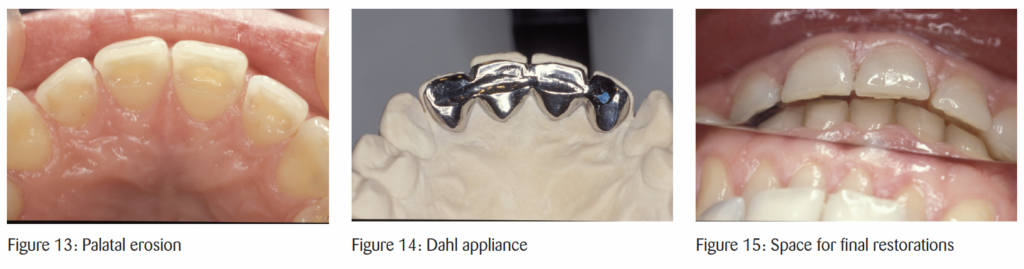
For localised anterior wear or erosion, the Dahl concept remains one of the most predictable and highly effective ways to gain restorative space. Whether using traditional appliances or modern additive restorative approaches, it provides reliable outcomes while preserving tooth tissue.
Its success still depends on the fundamentals: correct diagnosis, careful case selection, and functional control.
6) Accuracy in impressions and registrations: protecting the fit
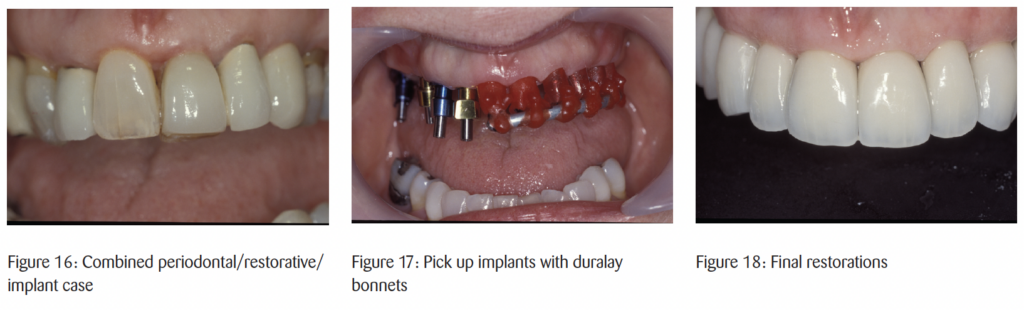
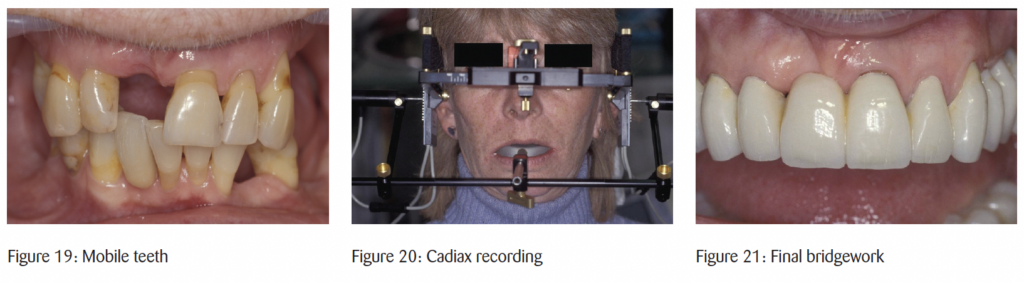
Larger restorative cases introduce variables not seen in routine crown and bridge work, such as mobile teeth, multiple implants, cross-arch discrepancies, and the need for stabilisation during record-taking.
Techniques that improve stability and accuracy—whether analogue or digital—can be the difference between a seamless fit appointment and a stressful, prolonged troubleshooting session.
7) Interdisciplinary thinking—and an aesthetic vision beyond “white”
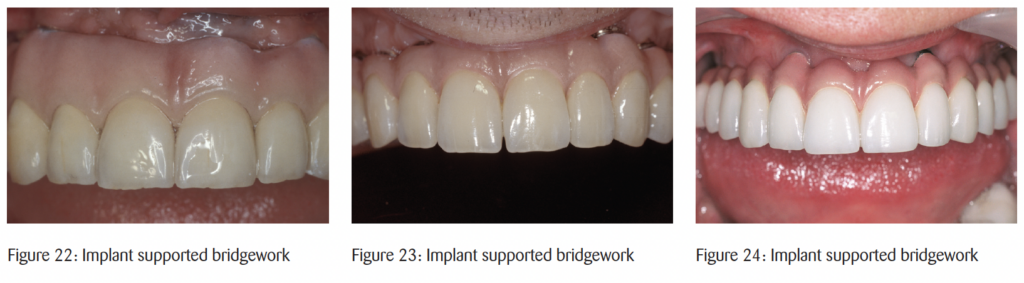
Advanced restorative dentistry rarely exists in isolation. Periodontal stability, endodontic considerations, orthodontic alignment, implant planning, and soft-tissue architecture all influence what is achievable and maintainable.
Patients today expect harmony between white and pink aesthetics. Modern restorative design must therefore integrate soft-tissue considerations—crown lengthening, tissue development, pontic design, and strategic periodontal-orthodontic planning—to achieve results that are both beautiful and stable.

Why Professor Tipton’s name matters
Many courses have copied what we teach. Fewer teach how to think—how to break down complex restorative decisions and rebuild them into predictable systems that work in real-world practice.
This is where Professor Tipton has made a lasting impact.
For more than three decades, he has refined a method of teaching restorative dentistry based on transferable principles rather than transient trends. With over 5,000 dentists trained, his influence on UK restorative practice is profound—creating clinicians who prioritise frameworks over fads, delivering dentistry that is predictable, functional, and long-lasting.
In recognition of his exceptional contribution to the profession, Professor Tipton became the first-ever recipient of the Kimberley Finlayson Lifetime Achievement Award at the 2022 Private Dentistry Awards. He also continues to be recognised annually among the UK’s top 50 most influential dentists and has been voted in the top 100 Dentists worldwide.
A practical next step: the 1-Year Certificate in Restorative Dentistry with Tipton Training
If these principles resonate, you are likely a clinician who wants more than tips—you want a complete, principle-led framework you can rely on, and you’re serious about your career development.
Tipton Training was created to deliver exactly that. As Professor Tipton’s own academy, it provides structured, principle-led postgraduate education built around the diagnostic and occlusal concepts he has refined throughout his career.
Tipton Training’s 1-Year Certificate in Restorative Dentistry is designed to turn these principles into day-to-day workflows, covering:
- diagnosis-led planning,
- occlusal control and predictable functional design,
- safe creation of restorative space,
- staged treatment protocols,
- dependable technician communication,
- and long-term clinical predictability.
A major advantage? The opportunity to learn directly from Professor Tipton—one of the UK’s few formally appointed Professors of Restorative & Cosmetic Dentistry, with a Master’s degree from a leading UK dental school, hundreds of publications to his name and decades of experience in modern restorative practice.
Training You Can Trust
Tipton Training is the only private dental training academy in the UK to hold accreditation from the Royal College of Surgeons of England (RCSEng). This accreditation was awarded following an independently conducted review of the academy’s programmes, teaching faculty, and state-of-the-art training facilities. For clinicians, it provides reassurance that the education they receive meets rigorous national quality standards and reflects best practice in postgraduate dental training.
Discover Tipton Training’s upcoming Restorative courses in Manchester, London, Glasgow, Belfast and Carlow, beginning Spring 2026